
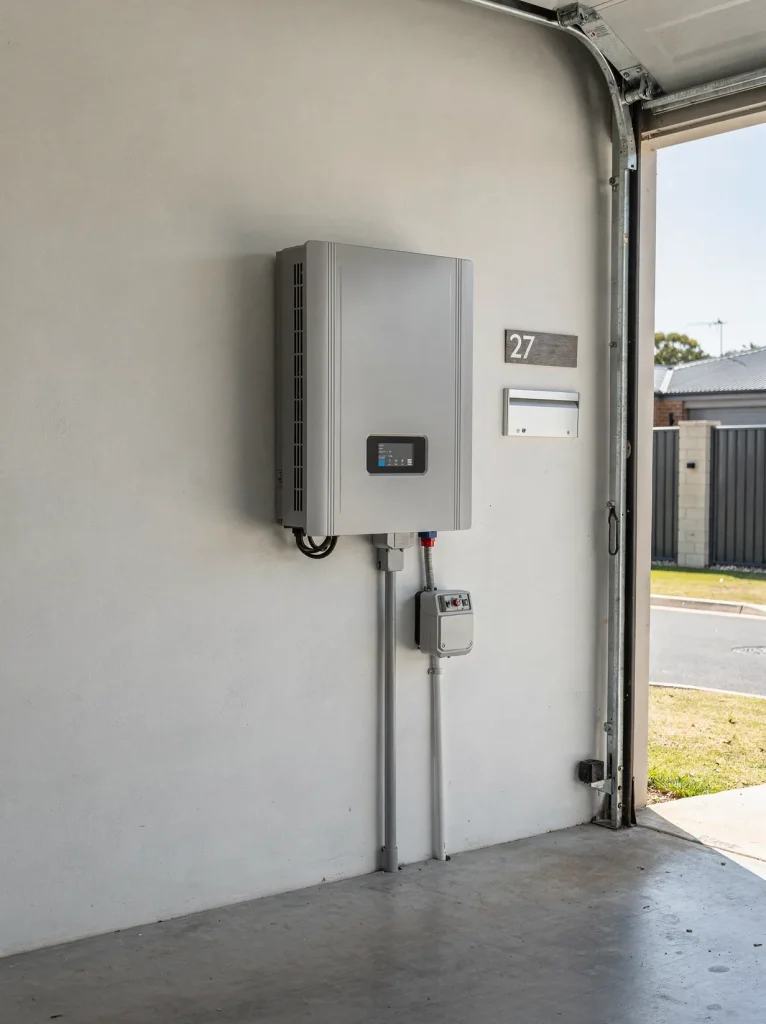
“Will it actually pay for itself?” is the question almost every Perth homeowner asks before committing to a battery. It’s the right question to ask, because a battery is a significant purchase and the answer depends heavily on your own usage. The maths only holds up when the system is sized correctly and the home battery installation is done properly by a professional, so the figures below assume a system matched to your household rather than a generic average.
Let’s treat the decision as a straightforward return-on-investment question and work through the numbers that actually matter.
The Core Payback Formula
At its simplest, battery payback is the upfront cost divided by the annual saving. But each part of that equation has moving pieces worth understanding.
The upfront figure is the installed cost of the battery after any rebates are applied. The annual saving comes from three sources:
- Stored solar you use at night instead of buying it back from the grid at the full retail rate.
- Avoided grid consumption during peak evening hours when tariffs are highest.
- Reduced reliance on feed-in exports, which typically earn far less than what you pay to buy power back.
The gap between what you pay for grid electricity and what you earn exporting solar is the engine of battery savings. The wider that gap, the faster a battery pays back. When you divide the net upfront cost by that yearly benefit, you get your break-even period in years.
How Current Rebates Reshape the Upfront Figure
Rebates matter because they attack the numerator of the payback equation directly. By lowering the effective purchase price, they shorten the break-even window without changing your daily savings at all.
Western Australian households can access support that meaningfully reduces the installed cost of an eligible battery. We won’t re-explain the mechanics here, but if you want the detail on who qualifies and how the state support works, our guide to the WA Residential Battery Scheme covers it in full. For payback purposes, the key point is simple: the rebate is a one-off reduction to your starting cost, and it can cut years off the time it takes to recover your investment.
Usage Patterns That Make a Battery Worthwhile
Two households can buy identical systems and see very different payback periods. The difference is when and how they use electricity.
A battery earns its keep by storing daytime solar for use later. That means the biggest winners are homes with high evening and overnight demand:
- Evening-heavy households that cook, run air conditioning, charge devices and do laundry after sunset get strong returns, because they’re displacing expensive grid power with stored solar.
- Homes that are empty during the day often export most of their solar for a low return. A battery captures that surplus and hands it back at night, sharply improving the value of each generated unit.
- Low self-consumption homes — those currently using only a small share of what their panels produce — usually see the fastest improvement, because a battery raises how much of their own solar they actually use.
By contrast, a household that already consumes most of its solar during daylight hours has less surplus to store. For those homes, payback stretches out because the battery has less work to do. Knowing your own daily pattern is the single most useful step in judging whether a battery suits you.
Perth’s Climate and Daily Returns
Perth’s generous sunshine is a genuine advantage for battery economics. A battery only saves money when it’s regularly filled and cycled, and consistent, high solar output means more days where the battery charges fully and delivers a full evening’s worth of stored power.
In cloudier climates, batteries can go long stretches only partly charged, which drags out payback. Here, the sheer reliability of daytime generation across most of the year keeps the battery working hard. More full cycles means more days you avoid buying peak-priced grid power, and those daily wins are what compound into a solid return over the system’s life.
Sizing and the Diminishing Returns of Oversizing
Bigger is not automatically better. A battery only pays back on the energy it actually stores and discharges, so capacity you never use is capital you never recover.
The ideal size matches your real overnight demand and the surplus solar you generate on a typical day. If your household uses a certain amount of stored energy each evening, a battery sized well beyond that will sit partly empty most nights — you paid for capacity that never earns its keep.
To size for good returns, consider:
- Your average evening and overnight electricity use.
- How much surplus solar your panels typically produce after daytime use.
- How much backup capacity you want for outages, if resilience matters to you.
Matching capacity to real demand keeps your cost-per-usable-kilowatt-hour low and your payback tight.
Beyond Pure Payback
Payback is the anchor, but it isn’t the whole story. A battery also delivers value that never appears in a simple break-even calculation.
Backup power during grid outages, greater independence from a network you don’t control, and protection against rising grid tariffs all add to the picture. As retail electricity prices climb, the value of every stored unit you use instead of buying grows too — meaning a battery’s savings often improve over time rather than staying flat. For many Perth households, that combination of financial return and energy security is what tips the decision.
One important caveat on all the figures above: the payback numbers assume a battery is claimed alongside the solar generation incentives most Perth homes already qualify for. The strongest returns appear when these two forms of support are combined rather than treated in isolation, and understanding how battery rebates and solar generation certificates work together is the next piece of the puzzle for anyone weighing up the maths.