
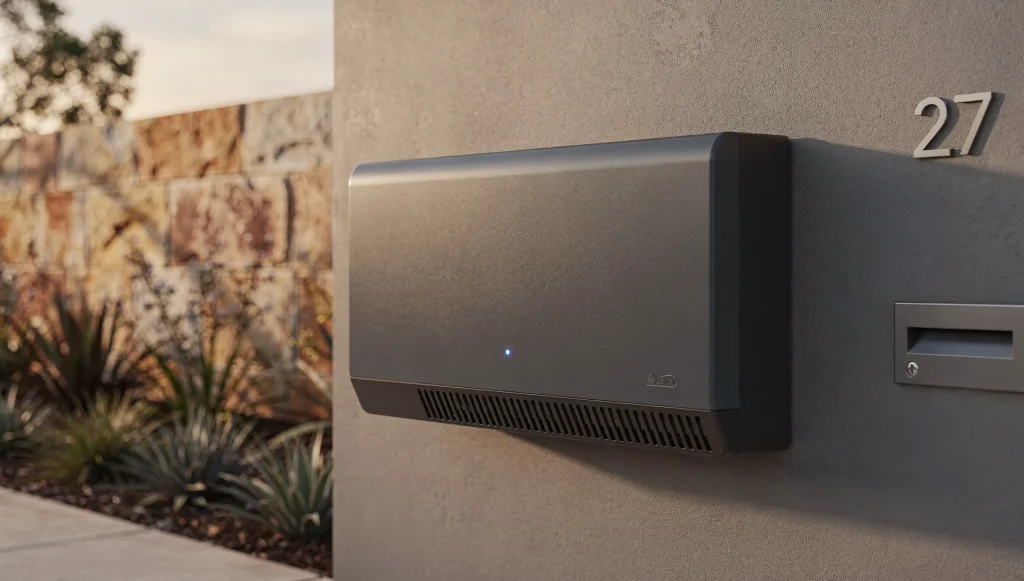
At its simplest, a home battery stores electrical energy so you can use it later. During the day your rooftop panels often produce more power than your household consumes, and a battery captures that surplus instead of sending it all back to the grid. Understanding how a home battery storage system works comes down to following that energy on its journey: in during the day, out in the evening, and back again the next morning. This explainer sits under the broader topic of solar battery storage, and it focuses purely on the mechanics rather than which product to choose.
Once you can picture the daily cycle, the rest of your decisions become far easier to weigh up.
The Core Components Inside a Home Battery Setup
A home battery storage system is more than just the battery pack. Several parts work together to move energy around your property safely and in a usable form. The iStore Battery is one option we install. A modular LiFePO₄ battery stack that pairs with an iStore hybrid inverter, suited to homes wanting flexible sizing and the option to scale up later.
- The battery cells store the energy. This is the component that charges and discharges over and over.
- The inverter converts electricity between the forms your home and battery need. Solar panels and batteries work in direct current (DC), while your household appliances run on alternating current (AC). The inverter handles this conversion in both directions.
- The management system monitors charge levels, decides when to store and when to release energy, and keeps the battery operating within safe limits.
The inverter is central to the whole process. When your panels generate DC electricity, the inverter either converts it to AC for your home or routes it to the battery for storage. Later, when the battery discharges, the inverter converts that stored DC energy back into AC so your appliances can use it.
The Charge Phase: Capturing Excess Solar During the Day
The charge phase usually begins mid-morning once your panels are producing more than the household is using. Rather than exporting all that surplus to the grid, the system directs the excess into the battery.
Think of a typical Perth day. Your panels might cover the fridge, air conditioning and other daytime loads with power to spare. That spare energy flows into the battery and builds up its stored charge through the sunniest hours.
Some systems can also charge from the grid, typically during off-peak periods when grid electricity is cheaper. This can be useful on cloudy days or in winter when solar generation is lower, so the battery still has stored energy ready for the evening. Grid-charging capability is a feature of certain systems rather than a given, so it is worth checking whether a particular battery supports it. The GoodWe Battery (Lynx) is one option we install. The Lynx range covers modular wall and tower batteries for GoodWe inverters, from a 5 kWh wall unit to a 28.8 kWh tower.
The Discharge Phase: Powering Your Home in the Evening
As the sun drops, solar production falls away while household demand often rises. This is when the discharge phase takes over. Instead of immediately drawing from the grid, your home pulls on the energy stored in the battery during the day.
The stored battery energy powers your household appliances first. Only once that stored energy is insufficient does the system draw on grid power to make up the difference. For many households, this means running on self-generated solar energy well into the evening, including through the peak demand hours when grid electricity is generally in highest demand.
The inverter is working throughout this phase too, converting the battery’s DC output into the AC electricity your lights, cooking appliances and devices rely on.
The Full Daily Cycle: Charge, Discharge, Repeat
Put the two phases together and you get a repeating 24-hour rhythm:
- Morning sun arrives and panels begin supplying the home.
- Midday surplus flows into the battery, building up its charge.
- Evening demand draws the stored energy back out to run the household.
- Overnight, once stored energy is depleted, the grid supplies what the home needs.
- The following morning, solar generation resumes and the cycle starts again.
If the battery empties before the sun returns, the grid simply steps in to supply the household’s energy requirements until solar production picks up. Nothing breaks and nothing switches off; the source of your power just changes seamlessly in the background.
How the Battery Works With Your Solar and the Grid
A home battery does not operate in isolation. It sits between your solar panels, your household loads and the grid, constantly balancing which source should supply power at any given moment.
During the day, solar is the priority. Energy covers the home first, surplus charges the battery, and any remaining excess can be exported. At night, the battery is the priority, with the grid acting as the backstop. This layered arrangement keeps the household supplied around the clock while making the most of the electricity your own roof produces.
Why Self-Consumption and Responsiveness Matter
The main benefit of this cycle is self-consumption: using more of your own solar energy rather than exporting it and then buying power back later. By storing the day’s excess and releasing it in the evening, a battery reduces how often you draw on the grid during peak times.
Batteries are also quick to respond. They can switch between charging and discharging promptly as household demand changes, which helps your system supply power smoothly as loads come on and off throughout the day.
How well a battery delivers on all of this in practice depends heavily on what it is actually built from inside. The cells that store and release the energy are not all the same, and the way they behave over thousands of charge-discharge cycles varies. That brings us to the different battery chemistries behind these systems, and why the material inside the pack shapes the performance you ultimately see.